How Is Sex Determined in Human Beings? A Complete Scientific Guide (2026)
sexualdoctors Team
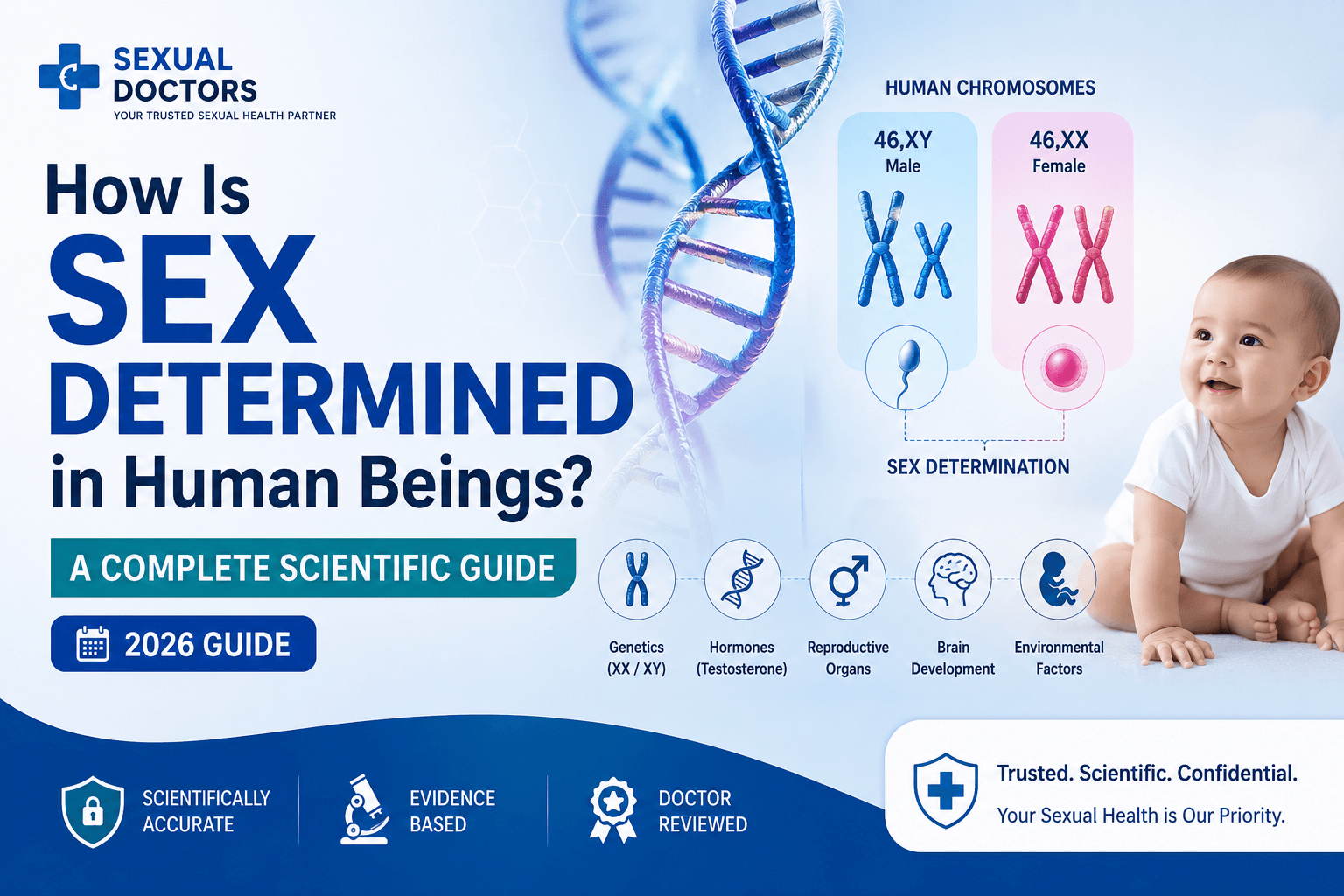
You probably learned in school that girls are XX and boys are XY. Simple, right?
Well sort of. That's a great starting point. But if you dig even a little deeper into human biology, you quickly discover that sex determination in humans is one of the most fascinating and nuanced processes in all of biology. It involves chromosomes, genes, hormones, timing, and a cascade of biological events that unfold over weeks inside the womb.
More importantly, understanding how biological sex is determined has real, practical relevance to reproductive health, sexual development, hormonal health, and even certain sexual health conditions that doctors treat every day.
This guide explains the science clearly, accurately, and without jargon from chromosomes and conception all the way to how sexual characteristics develop, and what happens when the process takes a different path.
What Exactly Is "Sex"?
Before we talk about how sex is determined, it helps to define what we mean.
Biological sex in humans is typically described across several layers:
-
Chromosomal sex the combination of sex chromosomes (XX or XY) inherited at fertilisation
-
Gonadal sex whether the gonads develop into ovaries or testes
-
Hormonal sex the pattern of hormones (oestrogen, testosterone, AMH) that shape development
-
Anatomical/phenotypic sex the external and internal reproductive structures that are visible or palpable at birth and develop further at puberty
Step One: The Chromosomes - What Happens at Fertilisation
Sex determination in humans begins at the exact moment of fertilisation, when a sperm cell fuses with an egg cell.
Here's the key biology:
Every human cell normally contains 46 chromosomes arranged in 23 pairs. Of these 23 pairs, 22 are autosomes (the same in both males and females) and 1 pair are the sex chromosomes either XX or XY.
-
Egg cells (produced by females) always carry an X chromosome. This is because females have two X chromosomes (XX), so each egg receives one X during the process of meiosis (cell division that produces reproductive cells).
-
Sperm cells (produced by males) carry either an X chromosome or a Y chromosome roughly 50% of sperm carry X, and 50% carry Y.
The sex of the child is therefore determined entirely by which sperm fertilises the egg:
-
Sperm carrying X + Egg (X) = XX → typically female
-
Sperm carrying Y + Egg (X) = XY → typically male
This is a crucial biological fact that has significant historical and cultural relevance: sex is determined by the father's sperm, not the mother's egg. The egg always contributes an X chromosome; the father's sperm contributes either X or Y. This is why the old cultural practice of blaming women for not producing a son is biologically backwards.
The Y chromosome is considerably smaller than the X chromosome and carries fewer genes but the genes it does carry are enormously powerful in directing development.
Step Two: The SRY Gene - The Master Switch
Carrying a Y chromosome doesn't automatically trigger male development on its own. The critical agent is a specific gene located on the Y chromosome called SRY the Sex-Determining Region on the Y chromosome.
The SRY gene encodes a protein called the Testis-Determining Factor (TDF). This protein acts as a transcription factor, essentially a biological switch that binds to DNA and triggers a cascade of gene expression.
Here is what happens, step by step:
-
Weeks 1–6 of development: The embryo is sexually indifferent. Both male and female embryos look identical during this stage. The developing gonads are bipotential; they have the capacity to become either ovaries or testes.
-
Around week 6–7: In XY embryos, the SRY gene is activated. TDF protein is produced.
-
SRY triggers SOX9, another gene that drives the bipotential gonadal tissue toward testis formation; specifically, it promotes the development of Sertoli cells, which are essential to male reproductive function.
-
In XX embryos, with no SRY gene, a different set of genes (including WNT4, RSPO1, and FOXL2) activate instead, directing the bipotential gonads toward ovarian development.
Step Three: Hormones Take Over
Once the gonads are established (either testes or ovaries), the story moves from genetics to endocrinology and this is where sex really starts to shape the body.
In XY Embryos (Developing Testes)
The newly formed testes begin producing two critical substances
1. Testosterone produced by Leydig cells in the testes. Testosterone (and its more potent form, dihydrotestosterone or DHT) drives the development of:
-
The male external genitalia (penis and scrotum)
-
The epididymis, vas deferens, and seminal vesicles
-
Male secondary sexual characteristics at puberty (facial hair, deeper voice, muscle mass)
2. Anti-Müllerian Hormone (AMH) produced by Sertoli cells. AMH causes the regression of the Müllerian ducts' embryonic structures that would otherwise develop into the uterus, fallopian tubes, and upper vagina.
So in a developing male, testosterone builds male anatomy while AMH actively removes the structures that would form female internal reproductive organs.
In XX Embryos (Developing Ovaries)
In the absence of testosterone and AMH:
-
The Müllerian ducts develop into the uterus, fallopian tubes, and upper vagina
-
The Wolffian ducts (which would form the male internal structures) regress
-
Female external genitalia develop from the same primordial tissue that forms the penis and scrotum in males (the clitoris and labia develop from the same embryonic precursors as the glans penis and scrotum)
The Role of Autosomes: It's Not Only X and Y
While the sex chromosomes are the primary determinants of biological sex, the process also involves genes located on the autosomes (the non-sex chromosomes).
Genes like WT1, SF-1, SOX9, DAX1, and FOXL2 located on various autosomes all play critical roles in the sex determination pathway. Mutations in these genes can alter sexual development even when the sex chromosomes are perfectly typical. This is one reason researchers describe sex determination as involving a complex gene network rather than a single binary switch.
Puberty: When Chromosomal Sex Becomes Visible
The chromosomal and hormonal work of sex determination happens largely invisibly inside the womb, in the first trimester. The outcome is established long before birth. But the most dramatic expression of biological sex comes during puberty, when the gonads (now established for years) begin producing sex hormones at high levels in response to signals from the brain.
In people with testes:
-
The pituitary gland releases LH (luteinising hormone) and FSH (follicle-stimulating hormone)
-
LH triggers testosterone production in the testes
-
Testosterone drives: penile growth, testicular descent, body hair, voice deepening, muscle development, sperm production
In people with ovaries:
-
The pituitary releases LH and FSH on a cyclical pattern
-
Oestrogen from the ovaries drives: breast development, uterine growth, redistribution of body fat, onset of menstruation
-
Progesterone supports the menstrual cycle
Understanding these hormonal dynamics is directly relevant to many of the sexual health conditions treated by specialists at SexualDoctors from hormonal imbalances affecting libido to conditions affecting sexual function in both men and women.
When Things Are More Complex: Variations in Sex Development
For most people, chromosomal sex, gonadal sex, hormonal sex, and anatomical sex all align seamlessly. But for a meaningful minority estimated at roughly 1.7% of the global population one or more of these layers may differ from the typical pattern. These are called Differences of Sex Development (DSDs), also historically termed intersex conditions.
Understanding these conditions is important not just scientifically, but because they directly affect sexual health and wellbeing.
Klinefelter Syndrome (XXY)
People with Klinefelter syndrome have two X chromosomes and one Y chromosome (47, XXY). The presence of the Y chromosome (and SRY gene) means testes develop and the person is typically male in appearance. However, the extra X chromosome affects testicular function often resulting in smaller testes, reduced testosterone production, infertility, and sometimes breast tissue development (gynecomastia). Klinefelter syndrome is more common than many realise, affecting approximately 1 in 500–1,000 males.
Hormonal and sexual concerns associated with Klinefelter syndrome are among the sexual concerns that certified sexologists manage regularly.
Turner Syndrome (45, X)
People with Turner syndrome have only one X chromosome and no second sex chromosome. Without the signals needed for full ovarian development, the ovaries often fail to develop completely (becoming streak gonads). This results in absent or incomplete puberty, infertility, and a need for hormone replacement therapy to develop secondary sexual characteristics.
Androgen Insensitivity Syndrome (AIS)
This is one of the most instructive conditions for understanding sex biology. A person with AIS has XY chromosomes and functioning testes that produce testosterone normally. However, the body's cells lack functional androgen receptors meaning they cannot respond to testosterone.
The result: despite XY chromosomes and testosterone production, the individual develops female external genitalia and typically a female gender identity. This powerfully illustrates that chromosomes alone don't determine anatomical sex the body's ability to respond to hormonal signals is equally critical.
Congenital Adrenal Hyperplasia (CAH)
In this condition, XX individuals (with ovaries and a uterus) are exposed to high levels of androgens in the womb due to an enzyme deficiency in the adrenal glands. The excess androgens can cause partial masculinisation of the external genitalia at birth, despite the person having a female chromosomal and gonadal profile.
What About the Father's Contribution? Debunking a Cultural Myth
This deserves its own section because it matters so much, particularly in the Indian context.
In many cultures including parts of India there has historically been social pressure on women for not producing male heirs. Daughters-in-law have been blamed, shamed, or mistreated for bearing girls.
The biology is unambiguous: a woman has no Y chromosome to give. She can only contribute an X. It is the father's sperm carrying either X or Y that determines whether the child is chromosomally male or female. A woman cannot influence whether her child is male or female any more than she can influence which of her partner's sperm wins the race to fertilisation.
This is settled, peer-reviewed science. Understanding it really internalising it has real implications for relationships and family dynamics. For couples navigating relationship strain rooted in cultural pressures or misunderstandings about fertility and reproduction, confidential support is available through SexualDoctors' relationship counselling service.
Sex Determination vs. Gender Identity: An Important Distinction
A medically accurate discussion of sex determination must briefly address the distinction between biological sex and gender identity because conflating the two causes confusion and, often, harm.
Biological sex refers to the chromosomal, hormonal, and anatomical characteristics described in this article. It is established at fertilisation and shaped through gestation and puberty.
Gender identity refers to a person's internal, psychological sense of their own gender — how they experience themselves in relation to maleness, femaleness, or neither. This is shaped by a complex interaction of biological, psychological, and social factors, and is distinct from biological sex.
This distinction matters clinically. At SexualDoctors, certified specialists approach each patient's sexual health with sensitivity to both biological and psychological dimensions, providing confidential, evidence-based, judgment-free care.
Why This Knowledge Matters for Sexual Health
Understanding how sex is determined isn't just academic. It has direct clinical relevance:
Hormonal health - The same hormones (testosterone, oestrogen, AMH) that determine sex during development continue to govern sexual function throughout adult life. Imbalances in these hormones are among the most common causes of sexual concerns including low libido, erectile difficulties, and arousal disorders.
Erectile dysfunction - The testosterone pathway that begins with the SRY gene continues to regulate penile blood flow, libido, and erectile function in adult men. Many cases of erectile dysfunction have a hormonal component either low testosterone or disruption of the hormonal signals that regulate erection.
Vaginismus and pelvic floor health The same embryological structures whose development is governed by sex hormones from the pelvic floor in adult women. Understanding the anatomical origin of these structures helps specialists diagnose and treat conditions like vaginismus.
STIs and reproductive health - Sexually transmitted infections including chlamydia, gonorrhoea, herpes simplex virus, and human papillomavirus affect the same reproductive organs whose development is described in this article and their treatment depends on a clear understanding of reproductive anatomy.
As highlighted in our detailed guide on sex during pregnancy, reviewed by specialists including Dr. Ibrahim Shakir, an understanding of reproductive biology is foundational to making safe, informed decisions about sexual health at every stage of life.
A Quick-Reference Summary
|
Factor |
Female (Typical) |
Male (Typical) |
|
Sex chromosomes |
XX |
XY |
|
SRY gene |
Absent |
Present |
|
Gonads |
Ovaries |
Testes |
|
Key hormones |
Oestrogen, progesterone |
Testosterone, DHT, AMH |
|
Internal structures |
Uterus, fallopian tubes |
Vas deferens, seminal vesicles |
|
External genitalia |
Vulva, vagina |
Penis, scrotum |
|
Sex determined by |
Father's X sperm |
Father's Y sperm |
Consult a Specialist for Sexual Health Concerns
Understanding the biology of sex determination is empowering but when sexual health questions become personal, they deserve the attention of a qualified medical professional.
At SexualDoctors, India's most trusted platform for sexual health, IMA-certified specialists offer confidential consultations online or in your city for concerns related to hormonal health, sexual function, reproductive wellbeing, and relationship dynamics.
Over 10,000 patients have received expert, judgment-free care across 20+ cities including Delhi, Mumbai, Bangalore, Hyderabad, and Chennai with complete privacy and discreet, encrypted consultations available from anywhere in India through our online sexologist service.
Book your free confidential consultation →