Sexual Health Checklist: 10 Signs You Should See a Sexologist (2026 Guide)
sexualdoctors Team
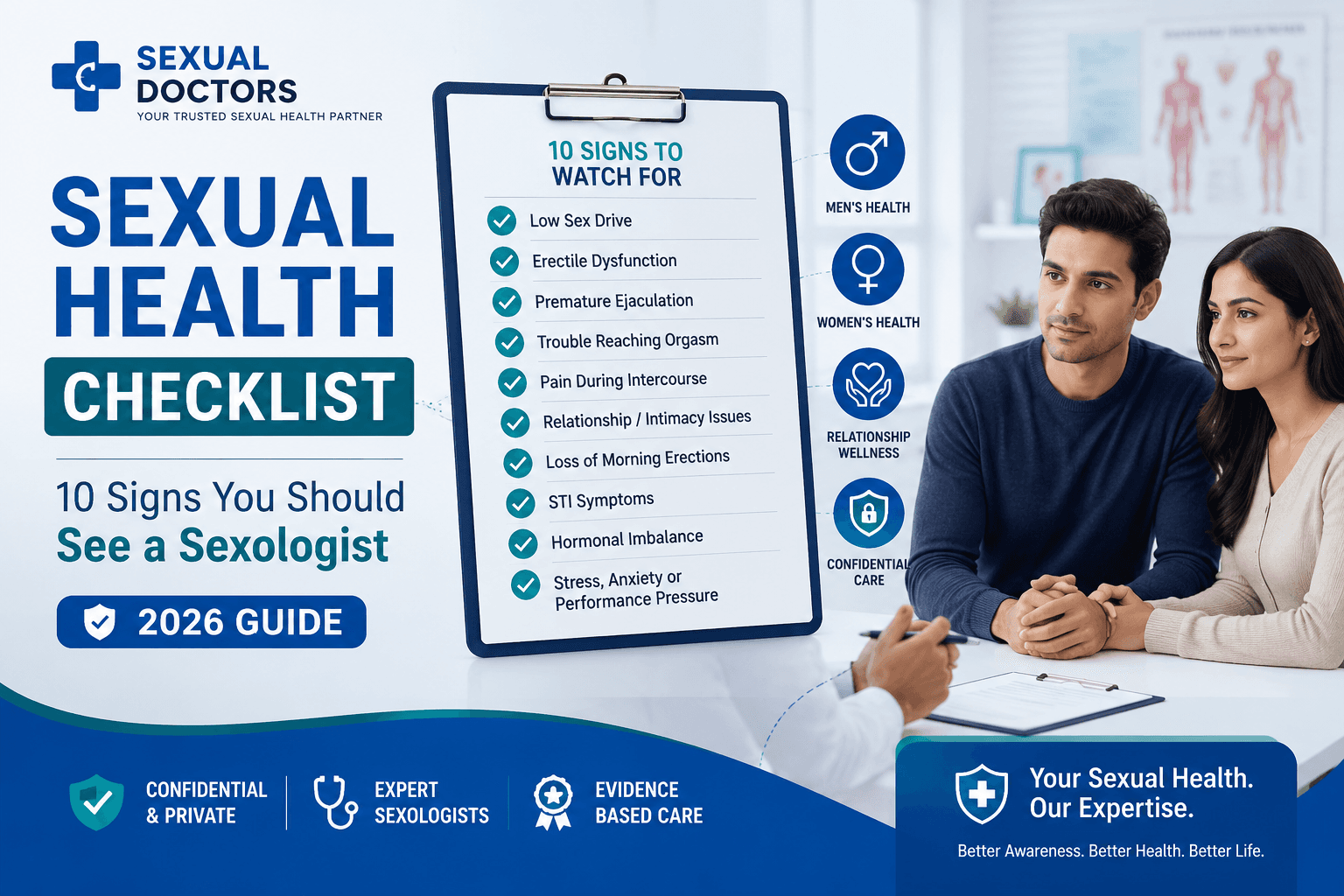
Sexual health is important for every male and female to live their life happily and peacefully. But unfortunately mostly people ignore their sexual health concerns. Most people will Google their symptoms for weeks. They'll ask a close friend who doesn't really know. They'll try a random supplement they saw advertised online. And they'll wait hoping it just gets better on its own.
It usually doesn't.
Sexual health problems rarely resolve by themselves. And the longer they go untreated, the more they compound affecting confidence, relationships, mental health, and quality of life in ways that spread far beyond the bedroom.
The question isn't whether you should see a sexologist. If something feels wrong, off, or unfamiliar about your sexual health the answer is almost always yes. The real question is: how do you know when it's serious enough?
This checklist answers that clearly. Go through each sign honestly. If you recognise yourself in even two or three of these, it's time to speak to a specialist, not next month, now.
What Is a Sexologist and What Do They Actually Do?
Before the checklist, a quick clarification because many people in India aren't entirely sure what a sexologist does, or whether they need one specifically.
A sexologist is a certified medical professional who specialises in the diagnosis and treatment of sexual health conditions physical, psychological, and relational. They're not therapists who just talk, and they're not GPs who give generic advice. They're trained specialists who understand the full clinical picture of sexual function and dysfunction.
At a platform like SexualDoctors, this means access to IMA-certified sexologists, urologists, gynaecologists, and psychosexual therapists all working together to assess your specific situation and build a personalised treatment plan.
Now the checklist.
Sign #1: You've Had Erectile Difficulties for More Than 4 Weeks
Getting a weak or incomplete erection once is normal. Stress, alcohol, fatigue, and a hundred other things can cause a one-off episode that resolves on its own.
But when it becomes a pattern happening consistently across most sexual encounters over a period of weeks that's erectile dysfunction (ED), and it's one of the clearest signals that you need specialist input.
ED affects an estimated 15.77% of Indian men, yet fewer than 20% ever seek help. Many men wait years, quietly managing the shame and the relationship strain it causes, before finally speaking to a doctor.
Here's what they almost always say afterwards: "I wish I hadn't waited so long."
ED can have vascular, hormonal, neurological, or psychological roots often a combination. Treatment is highly effective when the root cause is correctly identified. Self-diagnosing and reaching for random supplements online is not the same thing.
See a sexologist if: Erection difficulties are happening regularly, lasting more than 4 weeks, or affecting your relationship or self-confidence.
Sign #2: Sex Has Become Consistently Painful
Pain during sex is not normal. It is not something to simply push through or dismiss as "just how it is."
For women, pain during intercourse clinically known as dyspareunia can be caused by vaginismus (involuntary tightening of the vaginal muscles), vaginal dryness (often hormonal), endometriosis, pelvic inflammatory disease, or infections including STIs.
Vaginismus in particular is one of the most underdiagnosed conditions in women's sexual health. It's often confused with "low libido" or "not being in the mood," when in fact it's a specific, treatable condition that responds very well to guided pelvic floor therapy, dilator programmes, and psychosexual support.
For men, painful intercourse or pain during ejaculation can indicate prostatitis, urethral infections, or Peyronie's disease (scar tissue in the penis causing painful, curved erections).
In either case, pain is your body's clearest possible signal that something needs professional attention.
See a sexologist if: Sex is regularly painful before, during, or after. Don't normalise it.
Sign #3: You Ejaculate Within 1–2 Minutes and Can't Control It
This is the defining sign of premature ejaculation (PE) India's most common male sexual health condition, affecting 30–40% of men.
The clinical threshold is consistent ejaculation within 1–2 minutes of penetration, with minimal control, across most sexual encounters over at least a few weeks. One rushed encounter doesn't qualify as a persistent pattern.
PE is driven by a combination of psychological triggers (performance anxiety, early conditioning, stress) and biological factors (serotonin regulation, penile sensitivity). It almost never improves on its own once it becomes a consistent pattern, because the anxiety it generates tends to make it worse over time, not better.
The good news: PE is one of the most treatable sexual health conditions there is. With the right combination of behavioural techniques, psychosexual therapy, and where appropriate, medication (like dapoxetine), more than 95% of cases show meaningful improvement.
See a sexologist if: You consistently ejaculate sooner than you or your partner would like, and this is causing distress or conflict.
Sign #4: Your Sex Drive Has Significantly Dropped - For No Obvious Reason
A natural dip in libido after a stressful week, a poor sleep spell, or a period of illness is completely normal. That's not what this sign is about.
This sign is about a noticeable, sustained drop in sexual desire, one that's lasted weeks or months, that isn't explained by an obvious temporary stressor, and that feels meaningfully different from your baseline.
In men, this is often linked to declining testosterone levels, elevated prolactin, thyroid dysfunction, depression, or lifestyle factors (poor sleep, obesity, excessive alcohol). It can also be a side effect of certain medications.
In women, low libido is frequently connected to hormonal shifts particularly around perimenopause and menopause but can also reflect relationship strain, unresolved emotional issues, or a condition like hypoactive sexual desire disorder (HSDD).
Low libido that goes unaddressed doesn't just affect sex it often creates distance and resentment between partners that compounds over time. Exploring sexual concerns with a specialist early prevents this spiral.
See a sexologist if: Your interest in sex has dropped significantly and remained low for more than 4–6 weeks without a clear, temporary cause.
Sign #5: You've Noticed Unusual Discharge, Sores, or Genital Symptoms
This one needs no checklist. If you have:
-
Unusual discharge from the penis or vagina (different colour, consistency, or odour)
-
Sores, blisters, ulcers, or warts in the genital area
-
Burning or pain during urination
-
Swelling or lumps in the groin
...you need to see a doctor immediately. These symptoms are classic presentations of sexually transmitted infections (STIs) including chlamydia, gonorrhoea, herpes simplex virus, and human papillomavirus (HPV).
STIs are far more common in India than official statistics suggest largely because stigma prevents people from testing and reporting. Many STIs are entirely asymptomatic in early stages, meaning by the time symptoms appear, the infection may have been present for weeks or months.
Untreated STIs don't just go away. Chlamydia can cause infertility. Gonorrhoea is increasingly antibiotic-resistant if treated late. Herpes can be managed but not cured early management significantly improves long-term outcomes. HPV has links to cervical and penile cancers.
Getting tested confidentially at SexualDoctors is a fast, private, and non-judgmental sexual health clinic. Discreet medicine delivery means no one needs to know.
See a sexologist immediately if: You have any unusual genital symptoms, or if you've had unprotected sex with a new partner and are unsure of their STI status.
Sign #6: Intimacy Has Become Something You Actively Avoid
This is one of the subtler signs and one of the most important.
When sexual health concerns go unaddressed, avoidance becomes a coping mechanism. You find excuses. You go to bed earlier, or later, than your partner. You deflect. You manufacture reasons that physical intimacy isn't going to happen.
This isn't necessarily about a lack of attraction or love for your partner. It's often a sign of shame, fear of failure, fear of pain, or anxiety about performance all of which are clinical concerns that respond to treatment.
The danger of avoidance is that it creates a distance that can feel insurmountable to a partner who doesn't fully understand what's happening. Over time, that distance erodes trust, emotional connection, and the foundation of the relationship.
If you're actively structuring your life around avoiding intimacy, that pattern is already affecting your relationship whether or not you've had an explicit conversation about it. Relationship counselling alongside individual treatment is often the most effective path forward.
See a sexologist if: You find yourself consistently avoiding intimacy and making excuses and the thought of it causes anxiety rather than anticipation.
Sign #7: You or Your Partner Can't Achieve Orgasm
Difficulty with orgasm either inability to achieve it at all (anorgasmia) or a significant change in how easily or strongly orgasms occur is a clinical sign worth taking seriously.
For women, anorgasmia is remarkably common and remarkably under-discussed. It can be lifelong (never having experienced orgasm) or acquired (a change from a previous pattern). Causes span physical (nerve sensitivity, hormonal changes, medication side effects), psychological (anxiety, past trauma, body image concerns), and relational (communication, partner technique, emotional connection).
For men, delayed ejaculation the opposite of premature ejaculation is less common but equally distressing. It can result from antidepressant use (SSRIs in particular), hormonal issues, or psychological factors.
In both cases, the condition is treatable. But it requires proper assessment, not guesswork.
See a sexologist if: You've never experienced orgasm and would like to, or if orgasms have become significantly more difficult, weaker, or impossible compared to your baseline.
Sign #8: A Recent Medical Diagnosis Is Affecting Your Sexual Life
Several common health conditions have direct, well-documented effects on sexual function and many patients are never told about this connection by their primary doctor.
Conditions that frequently affect sexual health include:
-
Diabetes reduces blood flow and nerve function, a leading cause of erectile dysfunction
-
Hypertension (high blood pressure) both the condition and many medications used to treat it can impair sexual function
-
Thyroid disorders hypothyroidism and hyperthyroidism both affect libido, arousal, and ejaculatory control
-
Depression and anxiety directly affect libido and arousal; and many antidepressants have sexual side effects
-
Prostate conditions prostatitis and benign prostatic hyperplasia both affect sexual function and ejaculation
-
PCOS (Polycystic Ovary Syndrome) affects hormonal balance and can significantly reduce libido and sexual comfort in women
If you've been diagnosed with any of these conditions and have noticed changes in your sexual health since, a sexologist is precisely the right specialist to consult because this intersection of general health and sexual function is exactly their area of expertise.
See a sexologist if: You have an existing health condition — or have started a new medication and have noticed changes in your sexual desire, function, or comfort.
Sign #9: Your Relationship Is Suffering Because of Sexual Issues
Sexual problems rarely stay in the bedroom. They leak into every corner of a relationship conversations become tense, affection decreases, resentment quietly builds, and partners often blame themselves or each other without understanding what's actually happening.
Common scenarios:
-
One partner wants sex more than the other, creating a persistent mismatch in desire
-
Sexual dysfunction (PE, ED, vaginismus) has created an unspoken "elephant in the room" that neither partner knows how to address
-
A lack of intimacy has led to emotional withdrawal and loss of connection
-
Comparison to a former relationship or to unrealistic expectations (including those shaped by pornography) is creating tension
These are relationship concerns that certified couples therapists and psychosexual specialists work with every day. They're not signs of a failing relationship, they're signs of a solvable problem that needs the right professional support.
See a sexologist if: Sexual issues are creating emotional distance, conflict, or resentment in your relationship even if neither of you is sure exactly what the problem is.
Sign #10: You've Been Ignoring a Sexual Health Concern for More Than 3 Months
This final sign is the simplest and possibly the most important.
If something has felt wrong, different, uncomfortable, or unexplained about your sexual health for more than three months and you haven't spoken to a specialist, that delay itself is the sign.
Sexual health problems compound with time. Hormonal imbalances worsen. Infections spread. Relationship damage accumulates. Anxiety about performance reinforces the very dysfunction it fears. The one thing consistent across every sexual health condition is that early intervention produces faster, better, and more lasting results.
See a sexologist if: You've been aware of a sexual health concern for more than 3 months and haven't yet sought professional help.
Your Quick Checklist: How Many Apply to You?
Run through these honestly:
|
# |
Sign |
Applies to Me? |
|
1 |
Erection difficulties for 4+ weeks |
☐ Yes ☐ No |
|
2 |
Consistent pain during sex |
☐ Yes ☐ No |
|
3 |
Premature ejaculation — consistent pattern |
☐ Yes ☐ No |
|
4 |
Significantly reduced libido for 4–6+ weeks |
☐ Yes ☐ No |
|
5 |
Unusual discharge, sores, or genital symptoms |
☐ Yes ☐ No |
|
6 |
Actively avoiding intimacy |
☐ Yes ☐ No |
|
7 |
Unable to achieve orgasm or significant change |
☐ Yes ☐ No |
|
8 |
Medical condition affecting sexual function |
☐ Yes ☐ No |
|
9 |
Relationship suffering due to sexual issues |
☐ Yes ☐ No |
|
10 |
Ignored a concern for 3+ months |
☐ Yes ☐ No |
If you checked 1 or more: You have enough reason to book a consultation. There's no minimum number required.
If you checked 3 or more: Please don't wait. These patterns compound.
If you checked 5 or more: The impact on your quality of life and relationships is likely already significant. Professional support is genuinely urgent.
How to Get Help: Confidential Care Across India
Getting started is simpler than most people expect.
SexualDoctors connects you with IMA-certified sexologists, urologists, and psychosexual therapists online from anywhere in India, or in-clinic in your city. Trusted by over 10,000 patients across 20+ cities including Delhi, Mumbai, Bangalore, Hyderabad, Chennai, Jaipur, Pune, Kolkata, and Lucknow.
The process:
-
Book a free confidential consultation takes under 2 minutes
-
Speak privately with a certified specialist about your specific concern
-
Receive a personalised diagnosis and treatment plan
-
Follow up with ongoing support until you see real results
You can also reach our team directly on WhatsApp: +91 84548 32589 — 24/7, discreet, and immediate.